
Harmine, harmaline, harmala, and tetrahydroharmine are related terms, but they are not interchangeable. The shortest useful map is this: harmine and harmaline are individual compounds; harmala often names a wider family; THH is another related compound.
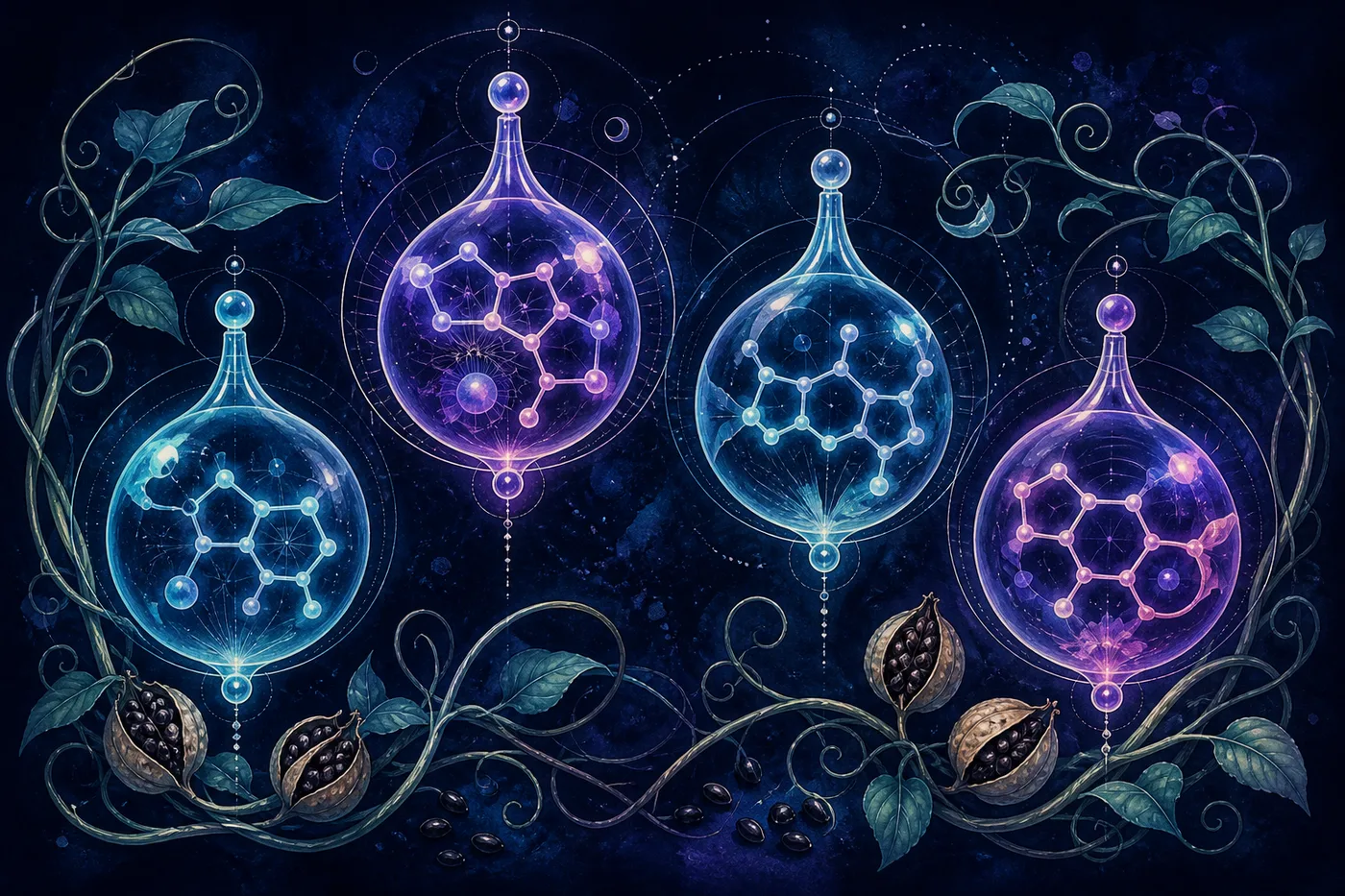
Conceptual comparison, not a formal chemical-structure diagram.
Harmine
Harmine is an aromatic β-carboline alkaloid. Historical chemical work found it in Peganum harmala and later identified it with material isolated from Banisteriopsis caapi under names including telepathine and banisterine. Its current database identity is a specific molecular structure, not a plant, product category, or preparation.
Harmaline
Harmaline is closely related to harmine but differs in hydrogenation and electronic structure. That small-looking structural difference changes physical, spectroscopic, and pharmacological behavior. It should not be treated as a spelling variant or assumed to substitute one-for-one for harmine.
Harmala
“Harmala” can refer to the plant Peganum harmala, to its common-name tradition, or to a class of related harmala alkaloids. Context determines the meaning. A phrase such as “harmala extract” does not specify which alkaloids are present, their proportions, or what testing was performed.
This ambiguity is one reason vendor language deserves careful reading. A family label is not the same thing as an identified, quantified compound.
Tetrahydroharmine (THH)
Tetrahydroharmine—commonly shortened to THH—is another β-carboline found in discussions of B. caapi. Its ring system is more reduced than harmine’s. Reviews describe meaningful pharmacological differences among THH, harmine, and harmaline, so collapsing them into a single “active ingredient” erases information.
Shared context, distinct profiles
Reviews of these alkaloids discuss monoamine oxidase A and other pharmacological targets, but the strength and nature of those interactions differ by compound and study conditions. Plant material and mixed extracts add further variability.
That variability has two practical consequences:
- A product name alone cannot establish composition.
- Related compounds may share interaction concerns without being pharmacologically identical.
Safety note: harmala alkaloids can create serious interactions with medications and other substances. This article is identification context, not use guidance. Do not stop prescribed medication based on website advice; consult a qualified clinician or pharmacist.
Read labels as claims to be checked
For any commercial listing, look for an unambiguous identity, lot linkage, test date, methods, named laboratory, and results that match the claim. “Fluorescent,” “natural,” “traditional,” and “high purity” are descriptions, not independently verified evidence.