
Under ultraviolet illumination, harmine can produce striking visible fluorescence. That glow is a property of how the molecule absorbs and releases energy—not a mystical signature and not a standalone quality test.
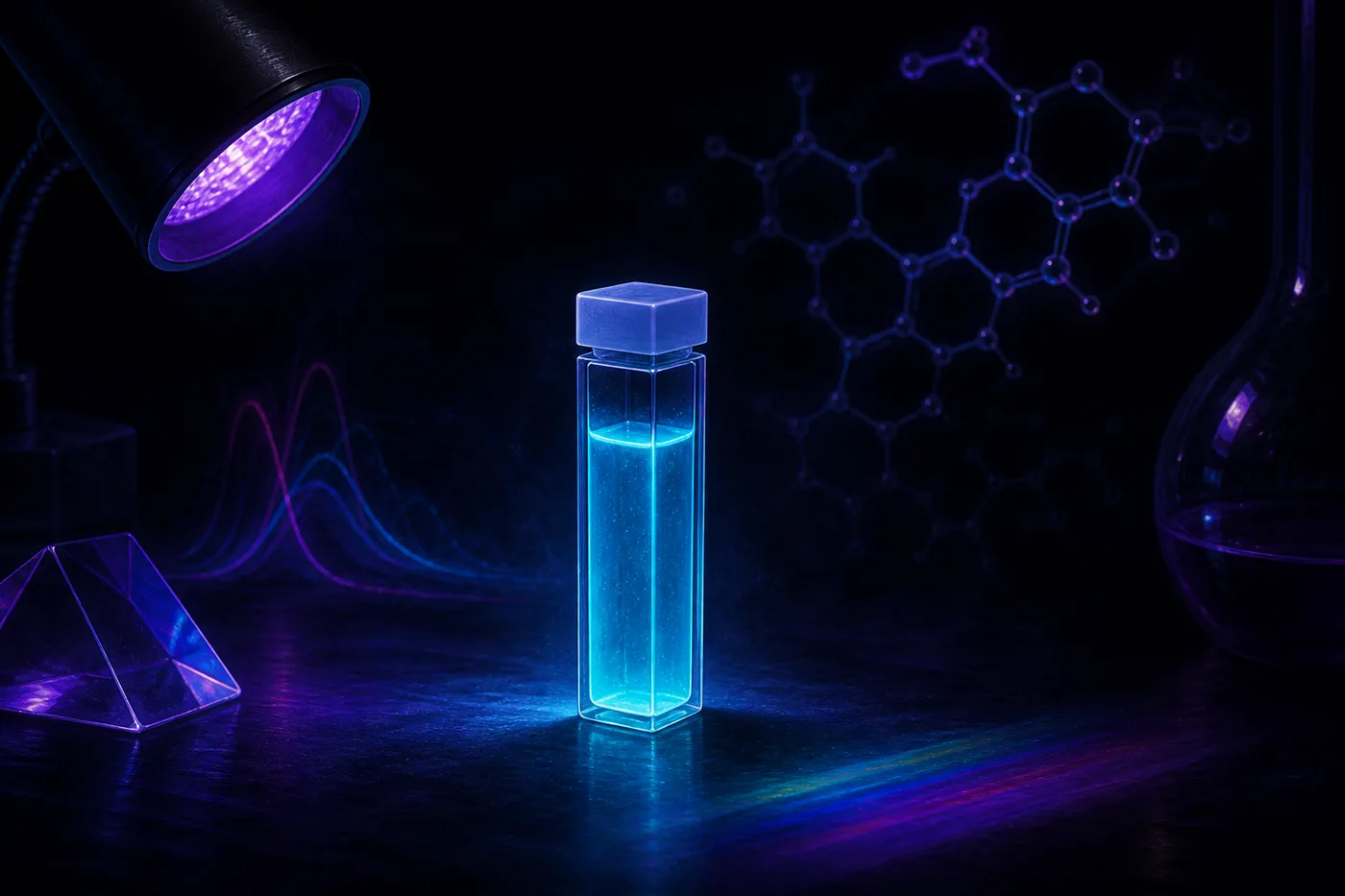
Editorial interpretation of fluorescence. The scene is illustrative, not an analytical protocol.
Absorption, relaxation, emission
Harmine contains a conjugated β-carboline ring system. When the molecule absorbs light at a suitable wavelength, an electron can move to a higher-energy state. Some energy is then lost through molecular motion and interaction with the surrounding medium. When the molecule returns toward its lower-energy state, it can emit a photon at a longer wavelength. Human eyes perceive that emission as visible fluorescence.
The emitted light is lower in energy than the absorbed light. That separation between absorption and emission is common in fluorescent molecules and is often called a Stokes shift.
The surroundings change the glow
Published spectroscopic work shows that harmine and harmaline do not have one immutable “UV color.” Fluorescence behavior can change with acidity, solvent, concentration, molecular aggregation, and which protonated form is present. Instrument settings and illumination wavelength also matter.
This sensitivity is useful to researchers because spectra can reveal information about molecular environment. It also makes casual visual comparison unreliable.
What fluorescence cannot tell you
A visible glow does not, by itself, prove:
- that a sample is harmine rather than another fluorescent material;
- that it contains no harmaline, plant compounds, solvents, or contaminants;
- how concentrated it is;
- whether it matches its label; or
- whether it is safe for any use.
Identity and purity claims require fit-for-purpose analytical methods, suitable reference standards, calibrated equipment, and interpretable documentation. A seller’s photograph under a UV lamp is not a substitute for a traceable laboratory report.
Fluorescence as a clue, not a verdict
The glow remains scientifically beautiful. It connects molecular structure to something directly visible and offers a good entry point into photochemistry. The disciplined interpretation is also the more interesting one: fluorescence is an observation whose meaning depends on conditions and controls.
Telepathine.net does not publish home-testing or handling procedures. If documentation matters for a purchase, ask the seller for a recent, lot-specific report from a named laboratory and evaluate what that report actually measures.